How to Map Market Structure: A Step-by-Step Guide
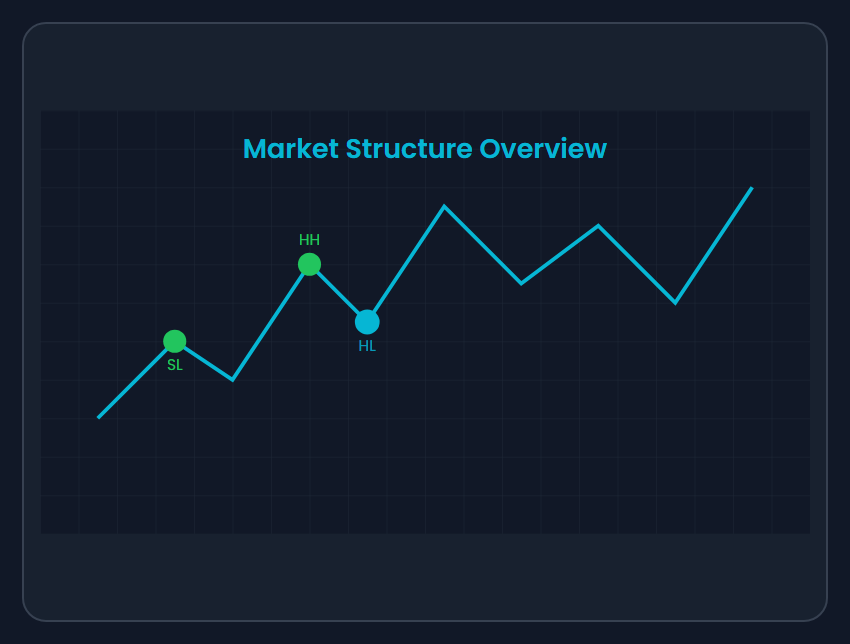
Most traders can tell you that a bullish trend makes higher highs and higher lows. Fewer can actually map that structure consistently on a live chart.
The problem isn't knowledge. It's subjectivity. Without clear rules, two traders looking at the same chart will draw completely different structure. One sees a higher low forming. The other sees a trend reversal. Both are guessing.
This guide gives you a systematic, rule-based approach to mapping market structure. Same rules, same chart, same result. Every time.
Why Structure Mapping Matters
Mapping market structure does three things:
- Tells you the trend direction — bullish or bearish, no guessing
- Defines your structural range — where continuation and invalidation points sit
- Prevents emotional decisions — the structure tells you when the trend changes, not your feelings
If you can map structure correctly, you always know:
- Which direction to trade
- Where your bias changes
- Where to enter and where to place stops
The Building Blocks
Before mapping, understand these components:
Swing Points
A swing high is a candle (or candle formation) with lower highs on both sides. It marks a peak.
A swing low is a candle (or candle formation) with higher lows on both sides. It marks a trough.
These are the anchors of market structure.
Impulsive Phase
Strong, directional moves with high momentum. Large-bodied candles. Clear direction. This is where structure is created — new highs in bullish trends, new lows in bearish trends.
Pullback Phase
Counter-trend corrections. Smaller candles, more wicks, lower volume. This is where structure is tested. The pullback creates the next swing point that will be used for mapping.
Step-by-Step: Mapping a Bullish Trend
Step 1: Find the First Swing Low
Look for a clear swing low formation — a candle with higher lows on either side. This is your starting point.
Step 2: Follow the Impulsive Move Up
From the swing low, price should move impulsively upward. Look for large-bodied bullish candles with strong momentum.
Step 3: Mark the Swing High
When the impulsive move exhausts and you see a swing high formation (candle with lower highs on both sides), mark this as your first high.
Step 4: Define Your Structural Range
You now have a range:
- Bottom: Swing low (this is your invalidation point)
- Top: Swing high (this is your continuation point)
Everything happening inside this range is either part of the pullback or the beginning of the next impulsive move.
Step 5: Wait for the Pullback to Resolve
Price will pull back from the high. It might be simple (1-3 candles) or complex (multiple internal swings). Either way, you're waiting for one of two things:
- Price breaks above the high → Break of Structure → trend continues → mark new range
- Price breaks below the low → Invalidation → trend may be reversing → reassess
Step 6: Confirm the Break of Structure
When price breaks the continuation point (the high), confirm it:
- Minimum: Candle closes above the high (close break)
- Stronger: Hard close candle above the high (open AND close above, bullish candle)
Step 7: Mark the New Higher Low
After the break confirms, look at the pullback that just completed. The lowest point in that pullback becomes your new higher low. This is now part of your mapped structure.
Step 8: Create the New Structural Range
Your new range is:
- Bottom: The higher low you just identified (new invalidation point)
- Top: The new high being formed (new continuation point)
Step 9: Repeat
Continue mapping as long as the trend persists. Each break of structure creates a new range with new reference points.
Step-by-Step: Mapping a Bearish Trend
The exact same process, inverted:
- Find the first swing high
- Follow the impulsive move down
- Mark the swing low
- Define the structural range (high = invalidation, low = continuation)
- Wait for the pullback to resolve
- Confirm BOS when price breaks below the low
- Mark the new lower high (highest point of the pullback)
- Create new structural range
- Repeat
Rules for Consistent Mapping
These rules remove subjectivity:
Rule 1: Use Swing Candle Formations Only
Only mark swing points that show actual exhaustion — candle formations with confirmation on both sides. Random candles in the middle of an impulsive move are not swing points.
Rule 2: Break and Close, Not Wick
A break of structure requires a candle to close beyond the structural level. A wick past the level is not a valid break. For extra confirmation, wait for a hard close candle.
Rule 3: Use Pullback Extremes for Mapping
When identifying a higher low (bullish) or lower high (bearish), use the extreme of the pullback — the lowest low in a bullish pullback, the highest high in a bearish pullback.
This makes your invalidation points more conservative and reduces false signals.
Rule 4: One Timeframe at a Time
Map structure on your analysis timeframe first. Don't mix timeframes when mapping. You can have different structure maps on different timeframes, but keep them separate.
Rule 5: Structural Range Supersedes Internal Structure
Any highs and lows inside a structural range that don't break the range boundaries are internal structure. They're part of the pullback. Only updates to the range boundaries (continuation or invalidation breaks) change your macro structure map.
Common Mapping Mistakes
Marking every candle as a swing point Not every high or low candle is a structural swing point. Wait for confirmed swing formations with context on both sides.
Mixing timeframes A swing high on the 5-minute chart is not necessarily a swing high on the 4-hour chart. Map each timeframe separately.
Changing your map mid-pullback When a complex pullback starts forming internal structure, resist the urge to start mapping that internal structure as your macro trend. The structural range defines the macro trend, not the pullback internals.
Ignoring the pullback extreme rule Using the first low in a pullback instead of the deepest low for your higher low gives you invalidation points that are too tight. Use the extreme.
Putting It All Together
A properly mapped chart tells you everything:
| What You Know | How You Know It | |---------------|-----------------| | Trend direction | Series of HH/HL (bullish) or LL/LH (bearish) | | Current range | Last swing high and swing low | | Where trend continues | Break above continuation point | | Where trend invalidates | Break below invalidation point | | Where to enter | After BOS confirmation, on retest | | Where to place stops | Below invalidation point (with buffer) |
Key Takeaway
Market structure mapping is not art — it's a system. With consistent rules for swing points, break confirmation, and range tracking, you remove the guesswork from trend analysis.
Start with one timeframe. Mark your swing points. Define your range. Wait for breaks. The structure will tell you everything you need to know.
Ready to practice? Our Structure Mapping module walks you through real examples, and the Market Structure module covers the foundational concepts.