Impulsive vs Corrective Price Action: How to Read the Market Phase
The market moves in two modes: push and pause. Understanding which mode you're in right now is the difference between trading with momentum and getting chopped up in noise.
Impulsive moves push price in one direction with conviction. Corrective moves are the messy pauses between them. If you can identify which phase the market is in, you know whether to trade or wait.
The Two Phases
Impulsive Phase (Expansion)
The impulsive phase is where the market moves with purpose. Full-volume pushes in one direction. This is where trends are created and extended.
On the chart:
- Large-bodied candles with minimal wicks
- Candles closing near their extremes
- Consistent direction (mostly green in bullish, mostly red in bearish)
- Volume increasing with the move
- New structural highs or lows being formed
What it means: One side (buyers or sellers) has clear control. There's no indecision. The market is trending and you want to be on this side.
Corrective Phase (Contraction)
The corrective phase is the counter-trend movement after an impulse. It's where price pulls back, consolidates, or chops around before the next impulse.
On the chart:
- Smaller candles relative to the impulsive move
- Longer wicks on both sides (showing indecision)
- Mixed colors (green and red candles alternating)
- Lower volume than the impulsive move
- No new structural highs or lows — staying within the range
What it means: Neither side has control. The market is pausing, digesting the previous move, or setting up for the next impulse. Trading here is harder and riskier.
Why This Matters for Your Trading
The single most important application:
Trade impulsive phases. Avoid corrective phases.
Most losses come from trying to trade during corrections. The market is choppy, signals are unreliable, and stop losses get hit by random wicks. The high-probability trades are in the impulsive legs.
Impulsive Phase Trading
When you identify an impulsive phase:
- Trade in the direction of the impulse
- Entries are cleaner (momentum carries the trade)
- Stop losses are less likely to be hit by random wicks
- Targets are reached faster
- Risk-to-reward is naturally better
Corrective Phase Trading
When you identify a corrective phase:
- Reduce position size or step aside
- Don't fight the correction — it's noise
- Wait for signs of the next impulse beginning
- Use the correction to plan your next entry, not to take trades
How to Identify the Current Phase
Candle Body Size
The fastest tell. Compare the current candles to the recent impulsive move:
- Large bodies, small wicks → Impulsive
- Small bodies, large wicks → Corrective
- Bodies getting smaller → Impulse fading, correction starting
- Bodies getting larger → Correction ending, new impulse forming
Volume
Volume confirms the phase:
- High volume + directional move → Impulsive (real momentum)
- Low volume + choppy move → Corrective (no conviction)
- Volume spike at end of correction → Potential impulse starting
Candle Direction Consistency
During impulses, candles are mostly the same color:
- Bullish impulse: 4-5 green candles, maybe 1 red
- Bearish impulse: 4-5 red candles, maybe 1 green
During corrections, colors alternate frequently:
- Green, red, green, red — no consistency
Swing Point Formation
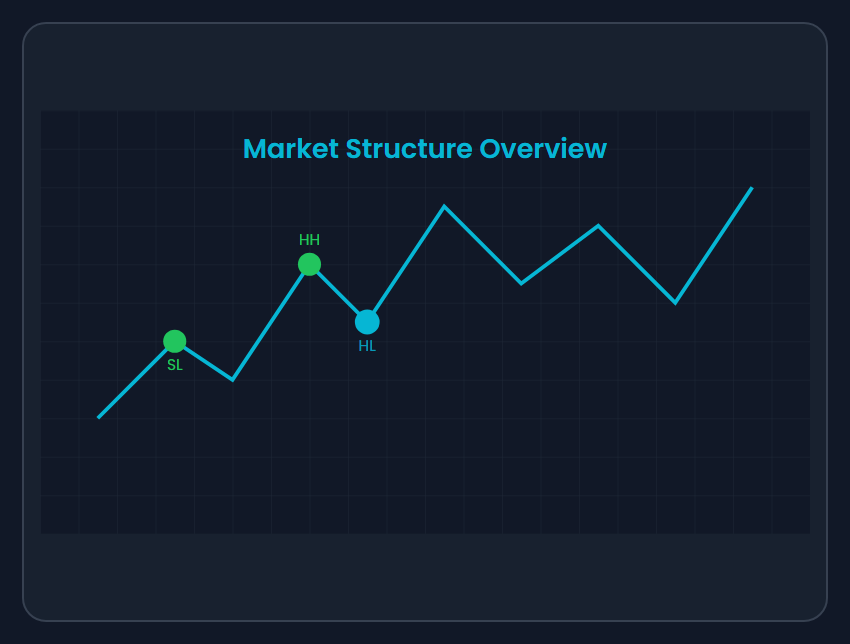
Impulsive phases create new swing points (new highs or lows). Corrective phases stay within existing swing points.
If price is making new structural highs → impulsive. If price is bouncing between the last high and last low → corrective.
The Transition Signals
Impulse → Correction
Signs the impulsive phase is ending:
- Candle bodies getting smaller
- Wicks getting longer (especially against the trend direction)
- A clear swing point formation (swing high after bullish impulse, swing low after bearish impulse)
- Volume decreasing
Correction → Impulse
Signs a new impulsive phase is starting:
- A strong, large-bodied candle in the trend direction
- Break of the correction's internal structure
- Volume increasing
- Candle closing near its extreme (minimal rejection wick)
Practical Framework
| Phase | Candles | Volume | Action | |-------|---------|--------|--------| | Impulsive | Large body, small wicks, consistent color | High | Trade with the impulse | | Corrective | Small body, long wicks, mixed colors | Low | Wait or reduce size | | Transition | Body size changing, wick pattern shifting | Changing | Prepare for next phase |
Key Takeaway
Before taking any trade, identify the current phase. If the market is impulsive, trade with it. If it's corrective, wait for the next impulse. This single filter will eliminate most of your losing trades caused by choppy, indecisive markets.
Learn more about market phases in our Market Phases module or explore how phases connect to Market Structure.