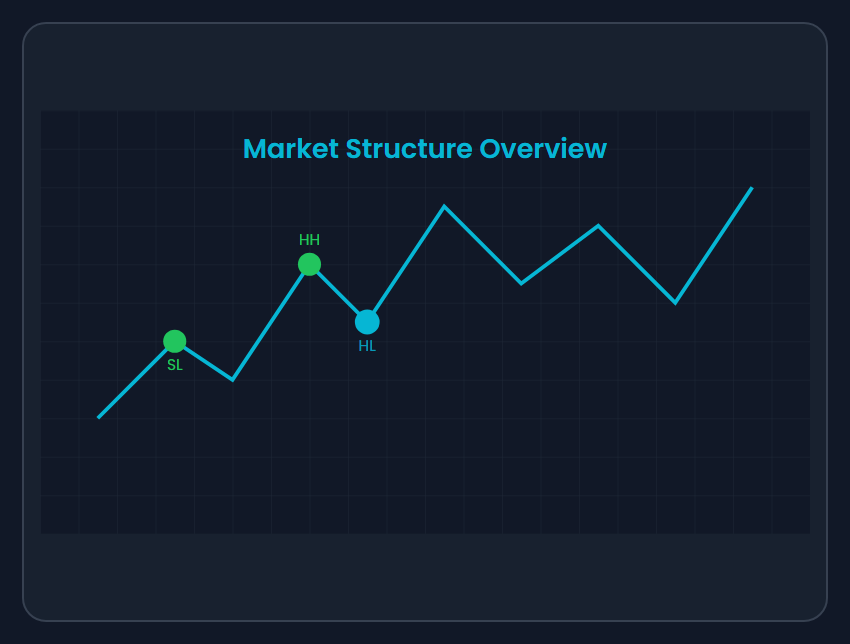
The 2 Phases of the Market: Impulsive vs Pullback
Understanding how markets move is fundamental to successful trading. Markets don't move in straight lines - they move in distinct phases that create structure. By learning to identify these phases, you can trade with the trend and avoid getting caught in choppy, unpredictable price action.
The Two Fundamental Phases
Every market, regardless of the asset or timeframe, moves in two distinct phases:
- Impulsive Phase - Strong, directional expansion
- Pullback Phase - Corrective, counter-trend movement
These phases alternate continuously, creating the market structure we see on our charts. Understanding which phase the market is in helps you make better trading decisions.
Impulsive Phase: The Expansion
The impulsive phase is where the real momentum happens. This is characterized by:
- Full volume pushes in one direction
- Large-bodied candlesticks showing strong buying or selling pressure
- Clear directional movement with minimal hesitation
- High trading volume confirming the move
During an impulsive phase, either buyers or sellers are firmly in control. The price moves rapidly, often breaking through previous resistance or support levels. This is also called the "expansion" phase because the market is expanding its range.
How to Identify Impulsive Moves
Look for these characteristics:
- Consecutive candles moving in the same direction
- Large candle bodies relative to recent price action
- Minimal or small wicks on the candles
- Price breaking through key levels with conviction
Pullback Phase: The Correction
After every impulsive move, the market needs to "breathe." This is the pullback phase:
- Low volume counter-impulsive movement
- Choppy, indecisive price action
- Smaller candle bodies with larger wicks
- Correction against the impulsive direction
Pullbacks are sometimes called "corrections" or "retracements." They represent a pause in the dominant trend where some traders take profits and others enter positions.
Characteristics of Pullbacks
- Price moves against the impulsive direction
- Volume typically decreases
- Candles show indecision (dojis, spinning tops, long wicks)
- Movement is often choppy and hard to predict
Why This Matters for Trading
Understanding these phases is crucial because:
Trade Impulsive Phases
The impulsive phase is where you want to be trading. Why?
- Clear direction means higher probability trades
- Strong momentum can carry your position to profit
- Less choppy price action reduces stop-loss hunting
Avoid Pullback Phases
Pullbacks are dangerous for several reasons:
- Choppy movement can trigger stop losses
- Direction is unclear and reversals are common
- Low volume means unpredictable price spikes
The key insight: Wait for the pullback to complete, then enter when a new impulsive phase begins.
Swing Formations: The Transition
Swing formations mark the transition between phases:
- Swing High: Forms when an impulsive up-move ends and a pullback begins
- Swing Low: Forms when an impulsive down-move ends and a pullback begins
These swing points are critical for:
- Identifying when phases are changing
- Setting stop losses and take profits
- Understanding overall market structure
Practical Application
Here's how to use this knowledge:
- Identify the current phase - Is the market impulsive or pulling back?
- If impulsive - Look for continuation opportunities with the trend
- If pulling back - Wait patiently for the pullback to complete
- Watch for swing formations - They signal phase transitions
- Enter on the new impulse - The safest entries come at the start of new impulsive phases
The Market Cycle
Markets constantly cycle through these phases:
Impulsive → Pullback → Impulsive → Pullback → ...
In an uptrend:
- Impulsive moves push price higher (higher highs)
- Pullbacks retrace but hold above previous lows (higher lows)
In a downtrend:
- Impulsive moves push price lower (lower lows)
- Pullbacks bounce but fail to reach previous highs (lower highs)
Key Takeaways
- Markets move in two phases: Impulsive (expansion) and Pullback (correction)
- Trade impulsive phases: High volume, clear direction, strong momentum
- Avoid pullbacks: Choppy, low volume, unpredictable movement
- Swing formations mark transitions: Use them to identify phase changes
- Be patient: Wait for pullbacks to complete before entering
Understanding market phases transforms how you read charts. Instead of seeing random price movement, you'll see a structured cycle that reveals trading opportunities.
Learn Interactively
Want to master these concepts with animated charts and quizzes? Check out our interactive slideshow:
Start Market Phases Interactive Course - Complete with visual examples and knowledge checks!